Tech & Wi-Fi
How onboard Wi-Fi drives revenue and passenger experience
Discover how onboard Wi-Fi boosts revenue and satisfaction for Mediterranean ferry and cruise passengers, with data on ROI, network types, and pricing strategies.
06 April 2026
How onboard Wi-Fi drives revenue and passenger experience
TL;DR:
- Onboard Wi-Fi influences passenger satisfaction, loyalty, and booking choices in the Mediterranean.
- Reliable high-speed connectivity enables operators to sell tiered packages and boost revenue.
- Hybrid satellite/5G networks provide cost-effective coverage with fast return on investment.
Most Mediterranean travelers board their ferry or cruise ship thinking about the destination, the food, and the sea air. Very few stop to think about the Wi-Fi. Yet 63% of cruise passengers use the internet for several hours every single day at sea, with 80% connecting for entertainment or work. That number should get every operator’s attention. Strong onboard connectivity shapes reviews, repeat bookings, and direct revenue in ways most passengers never see. In this guide, we break down exactly how Wi-Fi at sea translates into real business value and a noticeably better journey for everyone on board. 🌐
Table of Contents
- Why onboard Wi-Fi matters to ferry and cruise operators
- Passenger behaviors: How entertainment, work, and connection drive revenue
- Infrastructure and ROI: Which network solutions pay off fastest?
- Overcoming challenges: Handling cost, congestion, and complaints
- The big picture: Why Wi-Fi is the new anchor for Mediterranean sea travel
- Unlock seamless connectivity: Make every journey more rewarding
- Frequently asked questions
Key Takeaways
| Point | Details |
|---|---|
| Wi-Fi boosts revenue | Operators gain direct sales from packages and see higher passenger loyalty and rebooking due to strong connectivity. |
| Passenger habits shape demand | Leisure, work, and social browsing mean over half the passengers rely on Wi-Fi for hours each trip, driving digital expectations. |
| Infrastructure choice matters | Hybrid satellite/5G networks deliver greater coverage and pay off in less than two years for most Mediterranean routes. |
| Smart pricing curbs complaints | Discounted and tiered packages help limit negative reviews and maximize uptake, especially at peak times. |
| Wi-Fi is now essential | Operators and travelers alike should view reliable Wi-Fi as a must-have for enjoyable and productive sea travel. |
Why onboard Wi-Fi matters to ferry and cruise operators
For a long time, onboard Wi-Fi was treated as a nice extra, something to mention in the brochure but not a core part of the business model. That thinking is outdated. Today, Wi-Fi directly influences carrier choice, passenger satisfaction scores, and repeat bookings across Mediterranean routes.
The revenue case is straightforward. Operators sell internet packages directly to passengers, creating an additional income stream that requires relatively low ongoing overhead once the infrastructure is in place. A single route with 800 passengers, where even 40% purchase a basic package, generates meaningful revenue per crossing. Scale that across a fleet and a full season, and the numbers become significant.
But the indirect revenue impact is just as important. Reliable onboard Wi-Fi improves customer loyalty, drives positive reviews, and actively influences which carrier a traveler books next time. In a competitive Mediterranean market where routes often overlap between multiple operators, a consistently strong Wi-Fi experience can be the deciding factor.
“Connectivity is no longer a perk. For Mediterranean ferry and cruise passengers, it’s an expectation built into the price of the ticket.”
Here’s a snapshot of how Wi-Fi performance maps to business outcomes:
| Wi-Fi quality | Passenger satisfaction | Repeat booking rate | Review score impact |
|---|---|---|---|
| Poor or no Wi-Fi | Low | Drops significantly | Negative mentions common |
| Basic, inconsistent | Moderate | Neutral | Mixed reviews |
| Reliable, tiered packages | High | Increases noticeably | Positive mentions frequent |
| High-speed, hybrid network | Very high | Strong loyalty driver | Excellent ratings |
The pattern is clear. Operators who invest in quality connectivity see it reflected in their ratings and their returning passenger numbers. Those who don’t are leaving both revenue and reputation on the table.
Passenger behaviors: How entertainment, work, and connection drive revenue
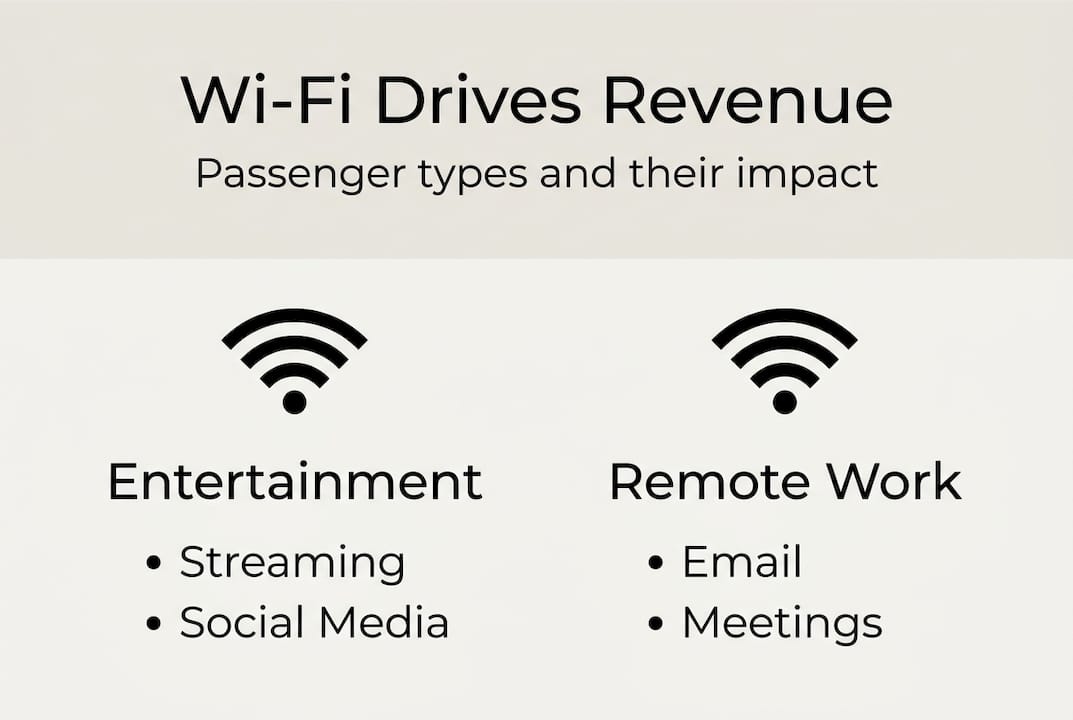
Understanding what passengers actually do with onboard Wi-Fi helps operators design packages that sell. The split is roughly two camps: those who want to stream, scroll, and stay connected socially, and those who need to work. Both groups spend money, but in different ways.
Entertainment Wi-Fi at sea covers everything from streaming a favorite show during a long overnight crossing to posting photos on social media or video calling family. These passengers typically want affordable access and consistent speed for light to moderate use. They’re price-sensitive but will pay for a reliable connection.
Remote workers are a different story. Wi-Fi for remote work on Mediterranean ferries has grown sharply. Some ferries have recorded a 30% productivity boost among passengers using premium connectivity packages, meaning travelers are genuinely getting work done at sea. These users pay more for higher speeds and priority bandwidth, making them the highest-value segment per head.

When connectivity fails, the cost is real. Passengers who can’t stream or work request refunds, leave negative reviews, and don’t rebook. That lost revenue compounds across a season.
Key differences between user types:
- Entertainment users: Want affordable, stable access for streaming and social media; moderate bandwidth needs
- Remote workers: Need high-speed, low-latency connections; willing to pay premium rates; generate highest per-passenger revenue
- Casual browsers: Light use, price-sensitive; respond well to short-duration or low-cost entry packages
- Families: Value ease of access and coverage across shared devices; bundle packages appeal most
| User type | Avg. spend per crossing | Bandwidth need | Package preference |
|---|---|---|---|
| Remote worker | High | Very high | Premium unlimited |
| Entertainment user | Medium | Moderate | Hourly or daily |
| Casual browser | Low | Low | Short-duration or free tier |
| Family group | Medium-high | High (multiple devices) | Multi-device bundle |
Pro Tip: Offer at least three package tiers: a budget option for casual browsers, a mid-range daily pass for entertainment users, and a premium plan for remote workers. Tiered pricing captures more passengers across all spending levels.
Infrastructure and ROI: Which network solutions pay off fastest?
Not all onboard Wi-Fi is built the same. The technology behind the connection determines coverage quality, cost to operate, and ultimately how quickly an operator sees a return on their investment.
There are three main approaches operators use today:
- Satellite-only networks: Traditional and widely deployed, but expensive to run and limited in coverage. Expect 60-70% coverage across Mediterranean corridors and high ongoing bandwidth costs.
- Hybrid satellite/5G networks: The current sweet spot. These systems combine satellite coverage for open-water stretches with 5G relay connections near coastlines. They achieve 80-90% coverage at medium cost, making them the most balanced option for most routes.
- Fleet-based 5G relay systems: Newer and increasingly viable near high-traffic coastal routes. Lower bandwidth costs but dependent on coastal 5G infrastructure.
Here’s how the three models compare:
| Network type | Coverage (Mediterranean) | Cost level | Payback period | Revenue potential |
|---|---|---|---|---|
| Satellite-only | 60-70% | High | 30+ months | Moderate |
| Hybrid satellite/5G | 80-90% | Medium | 18-24 months | High |
| 5G relay only | 70-85% (coastal) | Low-medium | 12-18 months | High (near coast) |
Fleet-based 5G relays and hybrid networks typically pay for themselves within 18-24 months through reduced satellite bandwidth costs alone, before factoring in increased package sales.
For operators considering an upgrade, the implementation process generally follows these steps:
- Audit current network performance and identify coverage gaps on your specific routes
- Evaluate types of onboard Wi-Fi solutions against your route profile and passenger volume
- Choose a hybrid model suited to your Mediterranean corridor
- Partner with a provider that integrates satellite technology (such as Starlink) with coastal 5G for seamless handoffs
- Launch tiered packages at go-live to maximize uptake from day one
- Monitor satisfaction scores and package sales monthly to refine pricing
Pro Tip: If your route stays close to coastlines for most of its journey, a 5G-heavy hybrid setup will cut your bandwidth costs faster. For longer open-water crossings, prioritize satellite quality first and layer in 5G where available. Explore high-speed Wi-Fi upgrades to understand what’s possible for your fleet.
Overcoming challenges: Handling cost, congestion, and complaints
Even operators with solid infrastructure run into friction. The most common passenger complaints about onboard Wi-Fi fall into three categories: it costs too much, it slows down when everyone connects at the same time, and it simply doesn’t work reliably enough to justify the price.
These are solvable problems. Here’s what actually works:
- Pre-purchase discounts: Offering 20-40% off packages when passengers buy before boarding removes the sticker shock and increases uptake. A basic plan starting at €4.99 for ferry crossings makes the entry point feel accessible.
- Tiered bandwidth allocation: Assign priority bandwidth to premium package holders during peak times. This keeps high-paying users happy and reduces the perception of slowdowns for everyone.
- Clear communication: Tell passengers upfront what peak times look like and what each package includes. Surprises at sea lead to complaints. Transparency prevents them.
- Capacity planning: Work with your provider to model passenger load by route and season. Overcrowded networks at peak summer crossings are predictable and preventable.
📊 Results that speak for themselves: After Seafy upgraded connectivity on Corsica-Sardinia ferries, operators saw a 25% increase in satisfaction scores and a 60% drop in connectivity complaints. That’s not a minor improvement. That’s a transformation in how passengers perceive the entire journey.
For passengers who do run into issues, having a clear path to troubleshoot ferry Wi-Fi problems or get onboard Wi-Fi quickly reduces frustration significantly.
Pro Tip: Place package option signage at boarding and in cabins, not just at the Wi-Fi portal. Passengers who know their options before they feel the need to connect are far more likely to purchase proactively rather than complain reactively.
The big picture: Why Wi-Fi is the new anchor for Mediterranean sea travel
Here’s a perspective that most operators still haven’t fully absorbed: Wi-Fi is no longer a service add-on. It belongs in the same category as fuel, food, and safety equipment. It’s a baseline that passengers expect before they step on board, and its absence or poor quality now shapes the entire perception of a journey.
The operators who understand this are already pulling ahead. They’re not just selling internet packages. They’re building digital ecosystems on board, bundling connectivity with entertainment, loyalty programs, and remote work amenities. Reliable onboard Wi-Fi positions Mediterranean lines as modern leaders, not just transport providers.
What most brands overlook is the word-of-mouth effect. A passenger who stays productive during a crossing, or streams their favorite show without buffering, doesn’t just rebook. They tell people. That organic advocacy is worth far more than any advertising spend.
If you want to understand why offering ferry Wi-Fi is now a strategic necessity rather than a differentiator, the data makes the case clearly. The future of Mediterranean sea travel is digital, and the operators who treat connectivity as core to their product will define what passengers expect from everyone else. ⚡
Unlock seamless connectivity: Make every journey more rewarding
If you’re a passenger looking for a reliable connection on your next Mediterranean crossing, or an operator ready to turn connectivity into a competitive advantage, Seafy has the tools to make it happen. We work with leading ferry lines including Corsica Ferries, Grimaldi Lines, and GNV to deliver proven, high-speed Wi-Fi solutions across the Mediterranean.
Explore Seafy onboard Wi-Fi to find the right package for your journey or to learn how our platform can help your fleet boost passenger satisfaction and grow revenue. From tiered packages to Starlink-powered satellite coverage, we make staying connected at sea simple, reliable, and worth every euro. Buon surf with Seafy! 🌐
Frequently asked questions
How does onboard Wi-Fi create revenue for ferry and cruise operators?
Operators earn directly from Wi-Fi package sales and benefit indirectly through improved customer loyalty and repeat bookings driven by a better onboard experience.
What are the main passenger uses of onboard Wi-Fi during Mediterranean cruises?
Most passengers connect for entertainment like streaming and social media or for remote work, with 63% using internet for several hours daily during their crossing.
How can cruise lines overcome high costs and slow connections for Wi-Fi?
Hybrid satellite/5G networks deliver 80-90% coverage at medium cost, and pre-purchase discounts of 20-40% make tiered packages accessible while reducing peak-time congestion complaints.
What kind of return on investment do hybrid Wi-Fi systems provide?
Hybrid systems typically pay for themselves within 18-24 months through reduced satellite bandwidth costs and increased revenue from higher package sales volumes.